65% OF BEDS ALREADY ASSIGNED
135 BEDS ALLOCATED TO UNIVERSITY RIGHT-TO-STUDY PROGRAMS IN AGREEMENT WITH PUBLIC UNIVERSITIES
- Agreement with Bocconi University and ongoing agreements on DSU rooms with state universities
- Following the success of the Olympic and Paralympic phase, with over 1,000 athletes hosted from more than 40 delegations, record redevelopment in 4 months and launch of the post-Games neighborhood activation
- Olympic Village as a flagship investment of the COIMA ESG City Impact Fund, backed by leading institutional investors and focused on social, environmental, and financial returns
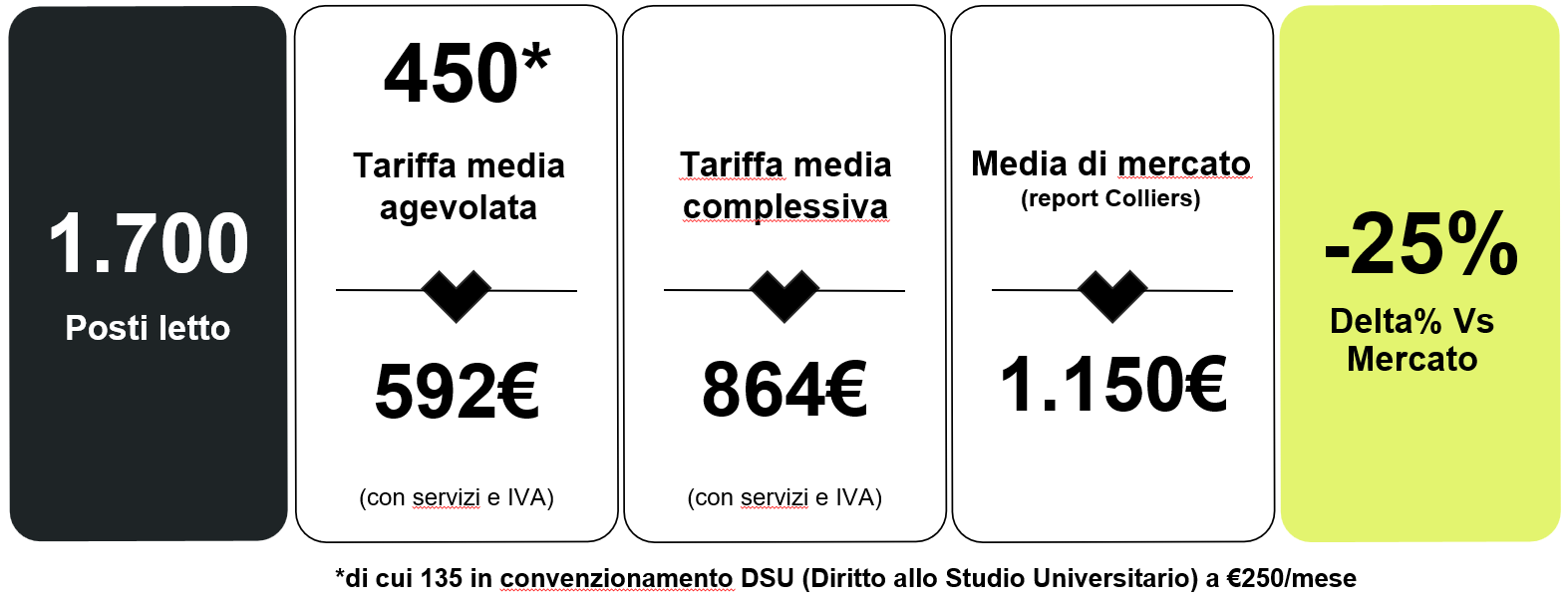
Milan, April 2, 2026 – The Milan Olympic Village – developed by COIMA SGR (“COIMA”), a leader in the investment, development, and management of real estate assets on behalf of institutional investors, and designed to become Italy’s largest affiliated student residence with over 1,700 beds—following the handover of rooms used during the Games by Fondazione Milano Cortina 2026, and after the success of the Olympic phase, is launching its conversion into a student residence. Within just six months from the start of bookings, 65% of the facility’s beds have already been assigned through agreements with universities and direct applications via the website. In addition, thanks to contributions from CDP Real Asset SGR and the Ministry of University and Research (MUR), which confirmed the Village’s compliance with the requirements set out in Ministerial Decree No. 481 of February 26, 2024 for the creation of new university housing, 450 beds are offered at subsidized rates, and for 30% of these (135 beds), a monthly rate of €250 has been introduced.
The Games and the redevelopment
During the Olympic weeks, the Village served as a multicultural hub, hosting more than 1,000 Olympic and Paralympic athletes from over 40 international delegations, including numerous medal winners. Through social media, many shared positive feedback on the quality of their stay: from the comfort of rooms and beds to the functionality of services, from the organization of shared spaces for socializing and rest to the attention to furnishings and design details. The harmony of these elements, which contributed to creating an environment conducive to high-level athletic preparation, reinforced the image of a modern, efficient Milan capable of meeting the expectations of the international Olympic community.
Today, following the handover of the rooms by Fondazione Milano Cortina 2026, the conversion of the Village into a student residence begins, the fastest ever for temporary events in Italy1 and among the fastest globally (4 months from April to July). The goal is to open the residence in August, in time for the start of the 2026/27 academic year, and to reach full occupancy by September 2026.
Redevelopment works include, externally, vehicle and pedestrian access, the construction of sports facilities, and the integration of green spaces and urban furnishings. Furthermore, from the outset, ground floors were designed with post-Olympic use in mind to minimize costs and waste. The approximately 10,000 sqm previously dedicated to athlete services, including gym, coworking, dining, and medical facilities, will be repurposed for activities and services aimed at activating both the neighborhood and the student residence. Internally, furnishings will be completed, particularly in the rooms (with the addition of desks and chairs not required during the Games), and conversion works will be carried out on lobbies and shared spaces (including kitchens, study rooms, and relaxation areas).
The future residence, with its 1,700 beds, will help meet 6% of Milan’s estimated student housing demand, currently around 30,000 beds compared to a total student population of 200,000. The project is one of the flagship investments of the COIMA ESG City Impact Fund (“Impact Fund”), among the first in Italy structured according to impact investing principles. Its aim is to generate simultaneous financial, environmental, and social returns based on predefined quantitative targets, within a strategy focused on redeveloping already urbanized areas and constructing fossil fuel-free, nZEB, energy Class A buildings. Since 2020, the Fund has mobilized approximately €5 billion through strategic partnerships and co-investments and has achieved global recognition for ESG performance, ranking as Global Sector Leader in the GRESB benchmark with a score of 99/100 and a 5-star rating.
Bed allocation
Launched on September 30, 2025 via the website and through engagement with local universities, bed allocation at the Village has already reached 65% of total capacity, as follows:
- 135 DSU (Right to Study) beds allocated in agreement with public universities
- 730 beds allocated to Bocconi University
- 245 beds assigned through direct applications via www.villaggio.coima.com
Of the 450 subsidized beds already planned, 30% (135 units) are offered at a further reduced rate of approximately €250 per month (VAT and services included), following confirmation of compliance with MUR requirements. Agreements for these rooms with Milan’s public universities are currently underway.
All beds include services designed to ensure safety, comfort, and social interaction: 24/7 security, 670 cameras, concierge service 7 days a week, 425 lockers, cleaning services, 6 laundry rooms, all utilities including Wi-Fi, 1,000 covered bicycle spaces, 42 kitchens, 2 gyms, and 42 study rooms and hobby areas (e.g., auditorium, cinema, music, and meditation).
Villaggio pricing
Villaggio is a private student residence included within the social housing quota (ERS) planned for the Scalo Romana district and, as such, operates under a regulated pricing system through an agreement with the Municipality of Milan.
Prices have been set to cover construction costs while ensuring long-term investors (such as pension funds, social security funds, and banking foundations) a 5% return, only slightly higher than that of 10-year Italian government bonds (BTPs), despite a significantly higher investment risk profile.
All rates are regulated and vary depending on room type (single or double), including VAT and all services related to safety, comfort, and social life. The average monthly rate of €864 (VAT and services included) is 25% lower than the Milan market average for serviced rentals (€1,150 per month). Additionally, thanks to contributions from the National Social Housing Fund (FNAS) managed by CDP Real Asset and the Ministry of University and Research (MUR), subsidized beds have tripled compared to the initial quota, reaching 450 units with an average monthly cost of €592 per bed (VAT and services included), of which 30% (135 beds) are allocated to DSU at approximately €250/month. Access to standard subsidized beds requires an ISEE certification below €44,000/year; DSU beds are assigned according to criteria defined by public universities.
Villaggio as a model of excellence
Designed as an open campus integrated with the neighborhood to become part of the city after the Games, the Scalo Romana student residence was completed in just 30 months thanks to close collaboration across the supply chain, involving Italian suppliers and expertise selected through a rigorous sustainability performance evaluation process, ensuring full compliance with nZEB (Nearly Zero Energy Building) standards.
During the Games, the facility operated without critical issues, hosting over 1,000 athletes who expressed appreciation for the quality of the structure and services, as well as its integration with the city.
In terms of inclusivity, the Paralympic Games served as a testing ground for accessibility features that will remain as a legacy: 5% of rooms (85 units) are fully accessible, and the entire complex has been designed to eliminate architectural barriers.
The future neighborhood
Villaggio is part of the new Scalo Romana district, which will accommodate more than 2,500 people through student housing and residential units within social and public housing schemes, contributing to the Municipality of Milan’s Housing Plan and the sustainable housing initiative promoted by Confindustria. In addition to the student residence, approximately 320 housing units will be developed under an agreement between COIMA and CCL (Consorzio Cooperative Lavoratori), including 220 conventionally priced units (with assignment costs below €4,000/sqm), which will help finance around 100 public housing units (ERP, with average rent of approximately €30/sqm per year). The partnership between CCL and COIMA aims to define a new entrepreneurial, urban, and financial model in residential development, focused on delivering affordable housing fully integrated within the neighborhood. This objective will be pursued by creating residential environments where free-market, regulated, and social housing coexist harmoniously, with a consistent architectural identity achieved through the involvement of emerging young professionals.
Collaboration between investors and institutions
The development of the Olympic Village was made possible through extensive collaboration between investors and institutions: Intesa Sanpaolo, as investor and lender together with Crédit Agricole and the Institute for Sports Credit through a €110 million Green Loan, and CDP, which—through CDP Real Asset SGR and the National Social Housing Fund—contributed to expanding subsidized housing capacity. These are joined by the Impact Fund, supported by major Italian pension and social security institutions, including Cassa Forense, ENPAM, Inarcassa, the Chartered Accountants’ Fund, the Intesa Sanpaolo Group, Compagnia di San Paolo, Fondazione Padova e Rovigo, Monte dei Paschi di Siena Pension Fund, ENPACL, and the National BCC-CRA Pension Fund.
The project was also supported by a broad institutional network including Regione Lombardia, the Municipality of Milan, Fondazione Milano Cortina 2026, CONI, the Ministry of Economy and Finance, the Ministry of Sport, the Ministry of Infrastructure and Transport, the Ministry of University and Research, and the FS Italiane Group.
1 2 years for Rome 1960, 17 years for Turin 2006, 10 years for EXPO 2025